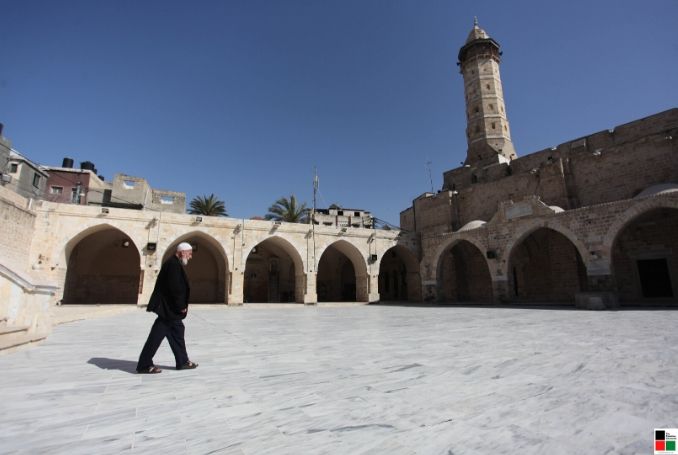
Gaza City, one of the oldest and most densely populated cities in the world, is home to a remarkable architectural treasure: the Al-Omari Mosque. This ancient mosque, which covers an area of 4100 square meters, is not only a place of worship for Muslims, but also a living testimony to the rich and diverse history of Gaza and its people.
The mosque stands on the ruins of a Roman temple, where the people of Gaza used to worship idols in the pre-Christian era. The temple was dedicated to Marnas, the god of rain and fertility, who was considered the patron deity of Gaza. The temple was later converted into a Byzantine church, named after the Empress Eudoxia, who sent 42 marble columns from Greece to adorn it.
However, the church was destroyed by the Persians in the 7th century AD, and soon after, Gaza was conquered by the Muslim army led by Amr ibn al-As. He built the Al-Omari Mosque on the site of the church, using some of the remaining columns. He named it after Omar ibn al-Khattab, the second caliph of Islam, who visited Gaza and prayed in the mosque.
The mosque witnessed many changes and renovations over the centuries, as Gaza was ruled by different dynasties and empires. The Crusaders turned it into a church again, called Saint John’s Church, which still exists inside the mosque as a basilica. The Mamluks restored it to a mosque and added a library that contained thousands of books and manuscripts. The Ottomans expanded it and added new features such as iwans (vaulted halls) and minarets.
The mosque survived wars and natural disasters, such as earthquakes and floods, but also suffered damages and destructions. It was restored several times by local authorities and religious figures, who preserved its original style and character. The mosque is still in use today, and it attracts visitors from all over the world who admire its beauty and history.
The Al-Omari Mosque is more than just a building; it is a symbol of Gaza’s resilience and identity. It reflects the cultural diversity and religious tolerance that have characterized Gaza throughout its history. It is a source of pride and inspiration for its people, who cherish their heritage and hope for peace.
The Legendary Philistine Roots
According to tradition, the mosque stands on the site of the Philistine temple dedicated to Dagon —the god of fertility—which Samson toppled in the Book of Judges. Later, a temple dedicated to Marnas —god of rain and grain—was erected. Local legend today claims that Samson is buried under the present mosque.
The Byzantine Church
The building was constructed in 406 AD as a large Byzantine church by Empress Aelia Eudocia, although it is also possible that the church was built by Emperor Marcian. The church appeared on the 6th-century Madaba Map of the Holy Land.
The Early Muslim Mosque
The Byzantine church was transformed into a mosque in the 7th century by Omar ibn al-Khattab’s generals, in the early years of Rashidun rule. The mosque is still named “al-Omari”, in honour of Omar ibn al-Khattab who was caliph during the Muslim conquest of Palestine.
The Crusader Church
In 1149, after capturing Gaza from the Fatimids, King Baldwin III of Jerusalem turned the mosque into a church again, called Saint John’s Church. He also built a castle near it to protect it from Muslim attacks. The church was decorated with Gothic elements and had three naves separated by columns.
The Mamluk Mosque
In 1187, after defeating the Crusaders at Hattin, Salah al-Din (Saladin) recaptured Gaza and restored it to a mosque. However, it was not until 1260 that his successors, the Mamluks, rebuilt it completely after it was destroyed by the Mongols. They added a library that contained thousands of books and manuscripts on various subjects such as religion, history, medicine, astronomy and poetry.
The Ottoman Mosque
In 1516, Gaza became part of the Ottoman Empire, which ruled it for four centuries. During this period, the mosque was expanded and renovated several times by different governors and sultans. They added new features such as iwans (vaulted halls), minarets, domes, fountains and courtyards. They also embellished it with tiles, inscriptions and paintings.
The Modern Mosque
In 1917, during World War I, British forces bombarded Gaza and damaged parts of the mosque. In 1925, under British Mandate rule, the Supreme Muslim Council restored it with the help of donations from the local community. In 1948, after the establishment of Israel, Gaza came under Egyptian administration, which also contributed to the maintenance of the mosque. In 1967, after the Six-Day War, Gaza was occupied by Israel, which imposed restrictions on the access and use of the mosque. In 1994, after the Oslo Accords, Gaza was transferred to the Palestinian Authority, which took over the responsibility of preserving and managing the mosque. In 2007, after Hamas seized control of Gaza, the mosque was affected by the Israeli blockade and siege, which limited its supplies and services.
The Future Mosque
Despite the challenges and hardships that Gaza faces, the Al-Omari Mosque remains a beacon of hope and faith for its people. It continues to serve as a place of worship, education and socialization for Muslims. It also welcomes visitors from other faiths and backgrounds who wish to learn about its history and culture. It is hoped that one day, the mosque will witness the end of the conflict and the dawn of peace in Gaza and beyond.
Shortlink for this post: https://daysofpalestine.ps/?p=44690