
DaysofPal – As Israeli and Hamas negotiators haggled over the final details of U.S. President Donald Trump’s peace plan, the small West Bank village of Taybeh, a rare, majority-Christian community, was living through a very different reality.
For the 1,300 residents of this hilltop village northeast of Ramallah, October’s olive harvest season has brought not peace but terror. Settler militias, emboldened and heavily armed, have turned the surrounding hills into zones of fear.
Terror in the Olive Groves
On a recent visit to Taybeh, villagers spoke of how what should be a season of blessing has become one of brutality.
Youssef Moussa, a 64-year-old Bedouin farmer, recounted how a settler gang stormed his tent while his family slept. They beat him unconscious, breaking two ribs, and ransacked his home. “When we assessed the damage, 7,000 dinars were missing,” he said quietly. “They took the gold my daughter-in-law received for her marriage and 85 sheep and lambs. It’s everything I had.”
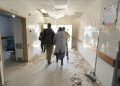
When an ambulance arrived, the Israeli army refused to open the gate blocking the village entrance, delaying his treatment.
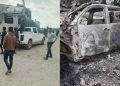
Across the West Bank, similar scenes unfold daily. Settlers, often masked, armed, and accompanied by soldiers, attack Palestinian farmers, burn crops, and destroy homes. In Turmus Ayya, northeast of Ramallah, they assaulted Palestinian farmers and international volunteers, torching vehicles and stealing harvests. Other attacks were reported near Nablus, Ramallah, and Bethlehem.
Human rights groups describe this wave of violence as a state-backed campaign to empty the land of Palestinians.
‘Fascist Militias’ and State Sponsorship
Jamal Juma, a Ramallah-based peace activist, calls the groups behind the attacks “fascist militias,” a term difficult to dispute. These armed settlers act with near-total impunity, often wearing military uniforms and receiving open backing from figures in the Israeli government.
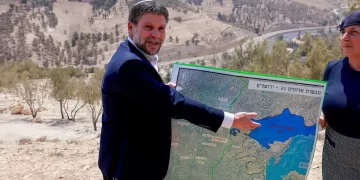
At the center of this machinery stands Bezalel Smotrich, Israel’s finance minister and leader of the far-right Religious Zionist Party. Smotrich is also a minister in the defense ministry, effectively functioning as the de facto governor of the West Bank.
He has long made his goals clear. In August, announcing approval of the massive E1 settlement project, 3,000 new housing units that would sever the West Bank from occupied East Jerusalem, Smotrich declared:
“The Palestinian state is being erased from the table, not with slogans but with actions.”
Smotrich’s blueprint calls for the annexation of 82 percent of the West Bank, confining Palestinians to fragmented enclaves. Western governments, while publicly supportive of a two-state solution, have done little to stop what even The Economist recently described as “annexation already happening.”
Taybeh’s Christian heritage, anchored by a fifth-century Byzantine church, has brought visits from high-profile Western officials. In July, U.S. ambassador Mike Huckabee visited after settlers set fire to the Al-Khader Church, condemning the “acts of terror and violence.” Soon after came U.S. senators Chris Van Hollen and Jeff Merkley and German foreign minister Johann Wadephul.
Yet none of these visits stopped the attacks.
Settlers now enter Taybeh itself, torching homes and olive groves, desecrating religious sites, and walking the streets with impunity. Israeli soldiers stationed nearby either ignore calls for help or actively protect the attackers.
This is not random violence, say local and international observers. It is a coordinated policy of forced displacement.
“A Grave Violation of International Law”
The Bethlehem-based human rights group Balasan calls Israel’s actions “a deliberate policy of forced displacement,” prohibited under international law and tantamount to a war crime.
Israeli human rights group B’Tselem says the goal is clear:
“To drive Palestinians off the land and seize as much territory as possible.”
Its latest reports describe “unprecedented” levels of violence since Israel’s assault on Gaza began, home invasions, arson, livestock theft, and the destruction of livelihoods, all carried out under military protection.
For two years, this slow-motion ethnic cleansing has unfolded largely unnoticed, overshadowed by the war in Gaza.
Despite this, Trump’s newly announced 20-point plan for Gaza makes no mention of Israel’s forced displacement campaign in the West Bank.
The omission is striking and perhaps intentional. Analysts suggest the plan was designed to preserve Israel’s far-right coalition, which depends on Smotrich and others who openly oppose Palestinian statehood.
For residents of Taybeh, it means the violence will continue unchecked.
“We are being erased from the map,” said one villager. “They want our land, our history, everything.”
In the hills above Jericho, in the valleys of Beita and Aqraba, and in the ancient olive groves of Taybeh, Palestinians are being pushed off their land, not by chance, but by policy.
Shortlink for this post: https://daysofpalestine.ps/?p=68632