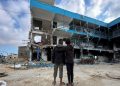
DayofPal—A new academic study has warned that Gaza is on the brink of producing a “lost generation” of children, as more than two years of Israeli genocide have devastated the education system.
The study, conducted by researchers at the University of Cambridge, found that children in Gaza have already lost the equivalent of five years of schooling, with the damage extending far beyond missed classroom time to include trauma, hunger, displacement, and the near-total destruction of educational infrastructure.
Researchers said the right to education for children in Gaza has been “almost erased,” as schools have been repeatedly targeted or rendered unusable, teachers killed or displaced, and families forced into constant survival mode.
Education System in Collapse
According to the report, there are approximately 1.5 million children aged six to 15 across Gaza and the occupied Palestinian territories.
In Gaza alone, the education of more than 740,000 students has been severely disrupted, while the lives and livelihoods of at least 27,000 teachers have been affected.
Nearly all schools in northern Gaza and Rafah have been damaged, while destruction has reached 98.4 percent of school buildings in Khan Younis and 93.3 percent in Gaza City.
Many of the remaining structures are being used as shelters for displaced families, leaving no physical space for learning.
Even after the ceasefire that took effect in October, researchers warned that educational recovery will take far longer than simply reopening schools, due to compounded trauma, starvation, and long-term psychological harm.
A Decade Behind
The study estimates that if schools remain closed until September 2027, many Palestinian teenagers will fall up to ten years behind their expected educational level.
The losses stem from repeated school closures since 2020, beginning with the COVID-19 pandemic and followed by sustained Israeli genocide
Children in the occupied West Bank have also been affected, losing a minimum of 2.5 years of education due to intermittent closures and escalating Israeli attacks.
Temporary learning initiatives introduced by UNRWA and the Palestinian Ministry of Education, including distance learning, have been largely undermined by damaged infrastructure, unstable internet access, continued bombardment, and severe shortages of basic resources.
Starvation, Trauma, and Blockade
The report highlights how Israeli restrictions have compounded the crisis by blocking educational and recreational materials from entering Gaza, as they are not classified as humanitarian goods.
As a result, basic learning supplies have become prohibitively expensive, with a single sheet of paper reportedly costing up to $3, and home-learning materials costing up to ten times their usual price.
Many children are now too weak to learn or even play, the study found, as malnutrition and trauma dominate daily life.
Researchers documented widespread despair among families, with teachers recounting parents asking why education matters when their children face death from famine.
As of October 1, 2025, the UN Office for the Coordination of Humanitarian Affairs (OCHA) reported that Israeli attacks had killed at least 18,069 students and 780 education staff in Gaza, while more than 26,000 students and 3,200 teachers were wounded.
Around 13,000 children were treated for acute malnutrition, and at least 147 died as a result.
Funding Gap and Urgent Needs
The study estimates that education recovery in Gaza will require at least $1.38 billion. Yet international support remains critically insufficient.
Of the $230.3 million requested by OCHA for education in 2025, only 5.7 percent had been funded by mid-year, amounting to roughly $9 per child.
Dr. Maha Shuayb, director of the Centre for Lebanese Studies, stressed that education must not be sidelined.
“Education and children’s services cannot be an afterthought,” she said. “They are a vital source of stability and care.”
Professor Pauline Rose, director of Cambridge’s REAL Centre, warned that the situation has deteriorated dramatically.
“A year ago we said education was under attack, now children’s lives are on the brink of a complete breakdown,” she said, calling on the international community to act urgently.
Professor Yusuf Sayed of the University of Cambridge added that thousands of new teachers will be needed to rebuild the system and support learning recovery, emphasizing that investing in educators is essential to preserving Palestinian identity and restoring hope.
Childhood Erased
Beyond statistics, the report draws a stark picture of childhood in Gaza, where bombardment, hunger, and fear have erased any sense of normal life.
Researchers warn that without immediate and sustained international intervention, the educational collapse will have irreversible consequences not only for individual children, but for Palestinian society as a whole.
Shortlink for this post: https://daysofpalestine.ps/?p=71091