DaysofPal- An investigation by Al Jazeera’s Sanad verification agency has revealed that the Israeli military is modifying commercial drones, originally designed for civilian and agricultural purposes, to conduct attacks and surveillance operations in the Gaza Strip.
According to the Sanad investigation, drones manufactured by the Chinese technology company DJI have been adapted by Israeli forces to carry explosives and monitor people in Gaza. These drones have been implicated in attacks on hospitals and civilian shelters and the tracking of Palestinian prisoners allegedly used as human shields, a violation of international law.
Among the most significant adaptations is the use of DJI’s Agras drone, originally intended for agricultural applications. With its ability to carry heavy payloads and execute precise flights, the Agras has been re-engineered to deliver bombs in densely populated civilian areas, often beyond the reach of traditional military hardware.
In addition, DJI’s Mavic and Avata drones, typically used for recreational filming and general surveillance, have also been repurposed for military objectives, including reconnaissance missions and mapping Gaza’s underground tunnel networks.
Not the First Time
The militarization of DJI drones is not unique to the Israeli context. During the Russia-Ukraine war in 2022, both sides reportedly modified DJI equipment for military use. In response, DJI halted all sales to both Russia and Ukraine and implemented geofencing software to restrict drone operations in specific areas.
However, no such action has been taken in response to the use of DJI drones by the Israeli military. Despite evidence collected by Sanad and presented in this investigation, DJI continues to sell its drones in Israel, and no flight restrictions have been applied to Gaza.
Documented incidents in Northern Gaza
By late 2024, Israel’s military campaign in northern Gaza had escalated significantly. UN officials described the conditions as “apocalyptic,” with widespread famine and mass displacement.
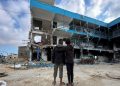
Footage shared by displaced civilians in July 2024 documented a DJI Agras drone dropping a bomb on a building operated by the Turkish humanitarian group IHH in Jabalia. The attack occurred just 100 meters from a school serving as a shelter and aid center.
In another incident in November 2024, a similar drone bombed a civilian neighborhood in Beit Lahia, where residents had taken refuge after Israeli strikes on a UN-run shelter. Witnesses described the attack as deliberately designed to instill fear.
Beyond direct strikes, DJI drones have been widely deployed for intelligence gathering and operational planning. One harrowing video captured by an Israeli-operated DJI Avata drone showed a Palestinian man in Shujaiya, December 2023, being forced to lead Israeli troops into a school, effectively serving as a human shield. Another drone monitored the operation, clearly recording the illegal act.
A Pattern of double standards?
In 2022, when Ukrainian authorities raised concerns that DJI products were being used by Russian forces, the company swiftly suspended sales and enforced technical limitations to prevent misuse.
Yet, despite mounting evidence of similar or worse abuses in Gaza, DJI has issued no comparable response. When questioned by Sanad, the company reiterated that its products are intended solely for peaceful, civilian use and condemned their use in causing harm. However, DJI did not answer follow-up queries about whether it would halt sales to Israel or introduce flight restrictions over Gaza.
Al Jazeera reached out to the Israeli military for comment on the findings but received no response by the time of publication.
The findings from Sanad’s investigation raise urgent ethical and legal questions about the commercial availability of drone technology and its weaponization in conflict zones. The contrast between DJI’s reaction to the Russia-Ukraine war and its silence regarding Israel’s use of drones in Gaza underscores a troubling inconsistency in how global companies address the militarization of their technologies.
Shortlink for this post: https://daysofpalestine.ps/?p=62762