
DaysofPal – The ceasefire declared on 10 October was meant to end two years of devastating war in Gaza. Instead, many Palestinians say it has created a “dangerous illusion” that life is returning to normal, even as Israeli military operations continue and civilians are still being killed.
When nine-year-old Jumaa and ten-year-old Fadi Abu Assi went out to gather firewood near their family’s tent in Khan Younis, their parents believed they were safe. Minutes later, an Israeli drone strike killed both children.
“After the ceasefire was announced, I felt a bit of safety,” said their mother, Hala Abu Assi. “I believed nothing would harm my children anymore. But fate had another plan.”
The UN reports that more than 360 Palestinians have been killed in Gaza since the ceasefire began, including at least 70 children. Although the death toll is far lower than the wartime average of 90 Palestinians killed per day, Israeli strikes still kill about seven people daily, an intensity that would be considered active conflict anywhere else.
Human rights organizations argue that the term “ceasefire” obscures continued violence. Amnesty International has warned that using the label risks misleading the world into believing normal life has resumed while masking ongoing harm.
A Ceasefire That Redraws Gaza
Central to the fragile situation is the “yellow line,” the boundary where Israeli forces repositioned after the truce. Israel was originally expected to retain control of 53% of Gaza, but it unilaterally expanded this to 58% by marking out additional territory.
Many Palestinians killed during the ceasefire were targeted for approaching this line. The Israeli military acknowledged striking the Abu Assi boys, describing the children collecting firewood as “suspects” who posed a threat.
This division has become Gaza’s new reality. The United States is preparing for an indefinite partition under which Israel and international forces control the eastern portion, described as a “green zone,” where limited reconstruction might eventually begin, while the western “red zone,” along the coast, remains devastated and largely uninhabitable.
Forensic Architecture’s analysis indicates that most of Gaza’s fertile farmland now lies inside the Israeli-controlled area, leaving the population confined to barren sand dunes with little infrastructure.
Uncertain Political Path and Stalled Plans
The political track envisioned in last month’s UN Security Council resolution remains unclear. The Trump-backed framework imagined further Israeli withdrawals and the arrival of an international stabilization force. These steps remain stalled.
Israel insists that no progress can occur until all remains of Israeli hostages are returned and Hamas is fully disarmed. Hamas says it is willing to discuss handing over offensive weapons, though not to Israel or anybody allied with Israel. This phase is politically unfeasible because nations that were supposed to support a stabilization force have declined to take part in the forcible disarmament of Hamas.
On the ground, the partition appears to be gaining permanence. Israeli forces have been constructing concrete outposts along the yellow line and expanding free-fire areas around them. In the territory they control, whole neighborhoods continue to be flattened despite commitments to reconstruction.
Israel has signalled that rebuilding will be allowed only within the “green zone.” Plans prepared by US officials envision the creation of “alternative safe communities,” fenced encampments where Palestinians would live in prefabricated shelters or shipping containers.
Residents would undergo strict vetting that excludes anyone with even distant relatives who had been paid by Hamas, regardless of whether the role was civilian or military.
Several humanitarian organizations and European governments have refused to participate in planning these encampments, warning they could amount to coercive displacement and violate international law.
These concerns are amplified by the fact that US planners have not addressed issues of land ownership or the destruction of homes and communities. Even if a pilot encampment planned for Rafah goes ahead, it would take at least six months to build and accommodate only about 25,000 people, roughly 1% of Gaza’s population.
Life Under the Ceasefire: Homelessness, Flooding, and Disease
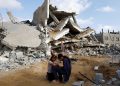
Living conditions are still appalling throughout the region. About 2.2 million Palestinians are now crammed into 42% of Gaza, much of it devastated. Nine in ten have no home to return to. Satellite data shows that more than 80% of housing units have been destroyed or severely damaged.
Most people live in fragile tents that have repeatedly flooded this winter. Heavy rainfall in November washed away hundreds, and possibly thousands, of shelters.
Sewage pits overflowed, pouring contaminated water into tented areas. UNICEF warns that waterborne diseases are spreading rapidly, with a sharp rise in acute watery diarrhea among children.
Aid deliveries have increased moderately since the ceasefire. Humanitarian and commercial trucks together now bring in more goods than during the preceding month, which has helped reduce the extreme prices seen earlier in the war. But most Palestinians have exhausted their savings after two years without work and cannot afford even the cheaper goods. Total imports still fall far short of Gaza’s pre-war average, while basic needs have multiplied.
Efforts by European and Arab states to support the Trump ceasefire framework are driven by hopes of keeping the United States engaged and preventing famine. Many have joined the Civil-Military Coordination Centre, a joint operations hub in southern Israel.
But analysts warn that without significant political progress, these governments risk entrenching a status quo that traps Palestinians in inhuman conditions while lending international legitimacy to an arrangement shaped by the Israeli military.
“There’s less international outrage now,” said Sam Rose of UNRWA, “but the fact is that people are living in miserable conditions and continue to be killed in spite of the ceasefire.”
Daniel Levy, a former Israeli negotiator, warned that the international involvement risks turning into complicity: “An army that has just committed a genocide now has dozens of militaries collaborating with it in its backyard.”
‘It feels as if the war is still ongoing’
For families trapped along the yellow line, the illusion of calm feels especially cruel. Faiq al-Sakani, who lives with his family of nine in the ruins of their home in Gaza City’s Tuffah district, said they hear tanks moving and gunfire every day. “Just yesterday, a group of my relatives was targeted. Three of them were killed, and several others were critically injured,” he said.
“It feels as if the war is still ongoing and there has been no ceasefire. There is no sign of normal life at all.”
Shortlink for this post: https://daysofpalestine.ps/?p=70107