DaysofPal – In a besieged territory still struggling to heal from a long and devastating war, a single Christmas candle was lit inside Gaza’s Holy Family Church, transforming prayer into a collective human stand and a powerful message of steadfastness. The celebration affirmed that the people of Gaza, across religious and communal lines, remain rooted in their land despite destruction, siege, and repeated attempts at displacement.
Christmas Mass was held at the Holy Family Church, also known as the Latin Monastery, in Gaza City in a calm and reverent atmosphere, attended by a limited number of Christian worshippers and clergy. It marked the first communal religious celebration since the ceasefire came into effect, following months during which religious rituals had been suspended due to Israeli bombardment and mass displacement across the city.
A Church That Became a Shelter
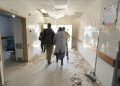
The Mass was not merely a religious occasion but an act of survival and a declaration of life. During the assault, the church itself served as a refuge for dozens of displaced families, both Christians and Muslims. Its external facilities sustained significant damage from nearby strikes and explosions, with shattered windows and cracked walls, while its surroundings remained unsafe for extended periods.
The Christmas celebration followed a three-day pastoral visit to Gaza by the Latin Patriarch of Jerusalem, Cardinal Pierbattista Pizzaballa, accompanied by Auxiliary Bishop William Shomali and several priests. The visit aimed to inaugurate the Christmas season, assess the condition of the Holy Family parish, identify priorities, and follow up on humanitarian relief and reconstruction efforts.
The delegation toured humanitarian projects and met with local clergy and parishioners, reaffirming the strong ties between Gaza’s Christian community and the Patriarchate of Jerusalem. Children welcomed the visitors with Christmas songs and symbolic activities that briefly restored a sense of joy to the damaged surroundings in the presence of parish priests and nuns.
Rebuilding Life, Not Just Surviving
In his remarks and Christmas homily, Cardinal Pizzaballa emphasized that the current phase is not only about surviving the war but also about beginning the long process of rebuilding life itself. He urged worshippers to carry the spirit of Christmas, its light, compassion, and love, despite the harsh reality.
Drawing parallels between the birth of Christ under harsh conditions and the situation in Gaza today, the Patriarch said the story of Christmas reflects the path of the poor and the marginalized. He stressed that history is not shaped by empires or force, but by the choices and steadfastness of people.
The Patriarch underscored that rebuilding is not limited to homes, schools, and infrastructure but begins with healing hearts. Love, he said, is the foundation of any genuine reconstruction after war and destruction.
A Rooted Christian Presence in Gaza
He reaffirmed that Gaza’s Christian community is deeply rooted in its land and will not become a marginal or temporary presence. Instead, it seeks to remain a stable reference point for life in a city exhausted by destruction, calling for unity and collective effort to rebuild Gaza materially and morally.
As part of the visit, the delegation also visited Saint Porphyrius Church of the Greek Orthodox community, meeting with the parish priest and highlighting Christian unity in Gaza amid shared suffering.
In a city where Christians number only a few hundred, suffering remains shared. The Christmas Mass reflected how steadfastness has become a unifying identity linking Muslims and Christians alike in their struggle for dignity, survival, and the right to life.
A Moral Message From Gaza to the World
A joint statement by several Christian clergy placed the Christmas celebration in a broader ethical context, questioning the meaning of celebration while Gaza continues to suffer from war, hunger, illness, and cold, and as violence escalates in both Gaza and the occupied West Bank.
During the Israeli offensive, the Holy Family Church was repeatedly damaged and surrounded by danger, yet it continued to shelter displaced families.
Holding Christmas Mass under these conditions became a message of resilience and continuity of Christian presence in Gaza.
In this sense, Christmas in Gaza was far more than a religious ritual. It stood as a human testimony to a city that refuses to be broken and a people, Muslims and Christians together, who affirm that Gaza will remain alive and that faith in life is stronger than all the tools of war.
Shortlink for this post: https://daysofpalestine.ps/?p=70718