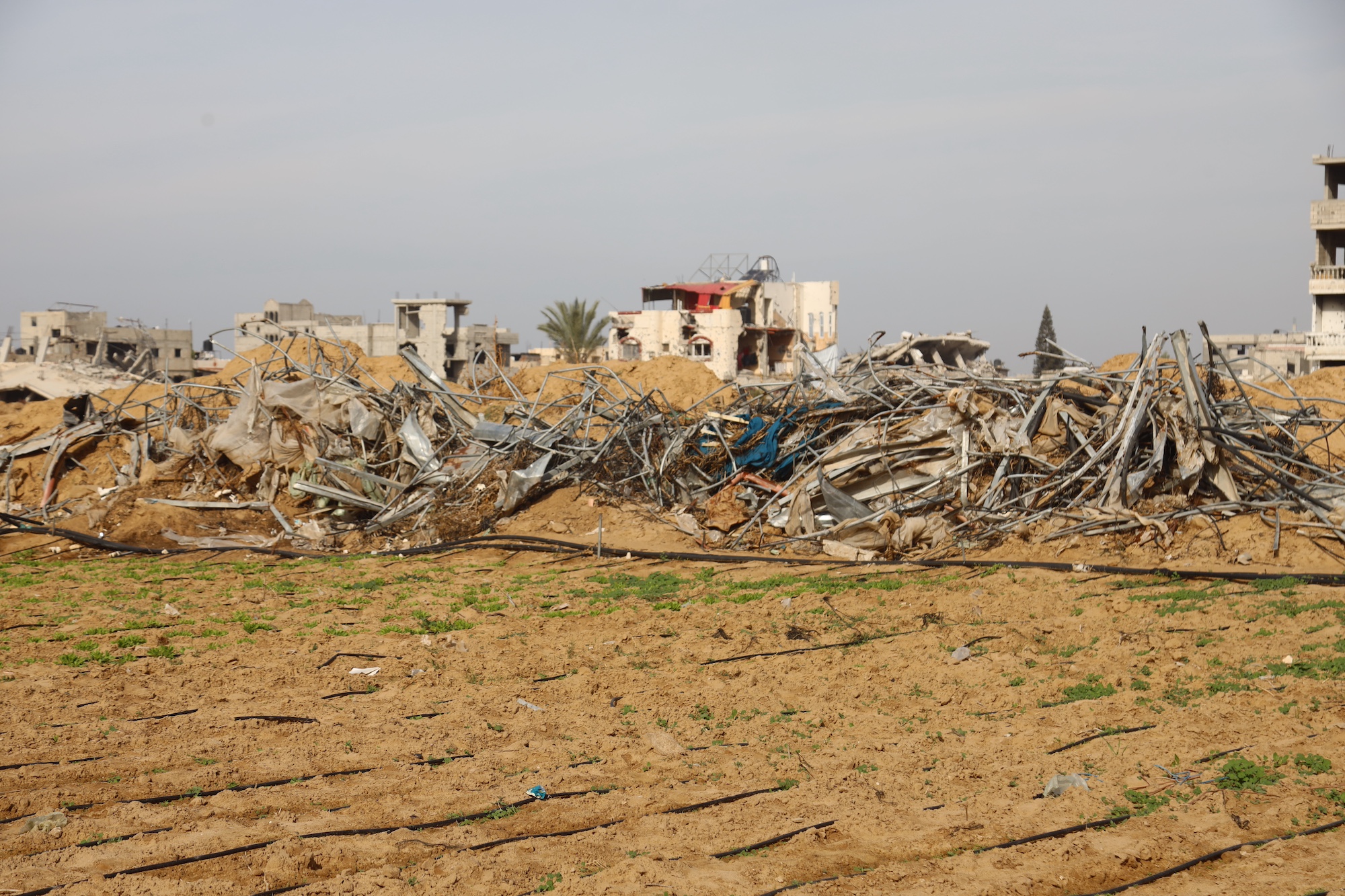
DayofPal– Less than five percent of the Gaza Strip’s cropland remains available for cultivation, marking a catastrophic decline in food production capacity and deepening the region’s hunger crisis, according to a new joint assessment by the Food and Agriculture Organization of the United Nations (FAO).
The geospatial analysis, conducted using high-resolution satellite imagery, reveals that over 80 percent of Gaza’s total cropland, 12,537 hectares out of 15,053, has been damaged due to ongoing war.
Nearly 78 percent of agricultural land is now inaccessible to farmers, leaving just 688 hectares, or 4.6 percent, available for planting.
The destruction is most severe in Rafah and the northern governorates, where almost all cropland is inaccessible. Greenhouses, a critical component of Gaza’s food supply chain, have also been decimated.
The report shows that 71.2 percent of greenhouses have been damaged, with Rafah experiencing the sharpest rise, from 57.5 percent damage in December 2024 to 86.5 percent in April 2025. In the Gaza governorate, every greenhouse has been rendered unusable.
Water sources for agriculture have also suffered extensive damage. The assessment reports that 82.8 percent of agricultural wells across Gaza are now inoperable, up from 67.7 percent just four months earlier.
“This level of destruction is not just a loss of infrastructure – it is a collapse of Gaza’s agrifood system and of lifelines,” said Beth Bechdol, FAO Deputy Director-General.
“What once provided food, income, and stability for hundreds of thousands is now in ruins. Rebuilding will require massive investment—and a sustained commitment to restore both livelihoods and hope.”
Before the war erupted in 2023, agriculture made up roughly 10 percent of Gaza’s economy, supporting over 560,000 people through farming, herding, and fishing.
But as the assault persists, that foundation has been obliterated. Earlier this year, FAO estimated the agricultural sector had sustained over $2 billion in damages and losses—$835 million in physical destruction and $1.3 billion in lost income.
Recovery and reconstruction were projected to require at least $4.2 billion, a figure likely to rise amid continued fighting.
The agricultural collapse comes amid stark warnings from the Integrated Food Security Phase Classification (IPC) analysis, which in its latest report signals that Gaza is on the brink of famine.
Between April 1 and May 10, 2025, 93 percent of the population, about 1.95 million people, were facing Crisis or worse levels of food insecurity (IPC Phase 3 or above).
Alarmingly, 244,000 people, or 12 percent of Gaza’s population, are now in IPC Phase 5 (Catastrophe), the most extreme level, indicating widespread starvation and imminent risk of death.
With the breakdown of ceasefire efforts and severe limitations on humanitarian aid, the FAO warns that Gaza’s agricultural devastation and deepening food insecurity could push the region into a full-scale famine without immediate international intervention.
Shortlink for this post: https://daysofpalestine.ps/?p=63291