Since the onset of the Israeli assault on Gaza on October 7 last year, public sentiment—both in the Arab world and internationally—has largely rallied in support of Palestine, condemning the violence and atrocities inflicted by the Israeli military on civilians.
In stark contrast, official reactions have varied widely. Some governments have offered unwavering support for Israel, both in rhetoric and action, while others have expressed sympathy for the victims in Gaza but failed to translate that empathy into meaningful action. There are also those who remain silent, providing no clear stance on the unfolding tragedy.
Arab Protests
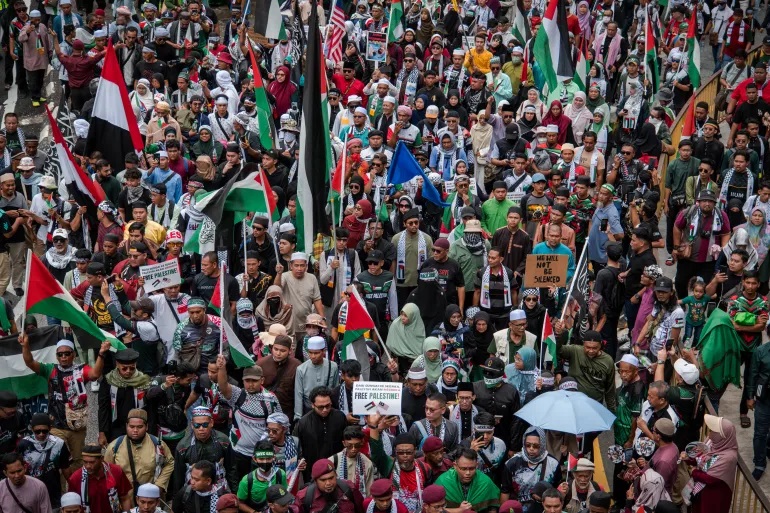
The protests sparked by the conflict primarily unfolded in nations that traditionally support Israel, alongside a handful of Arab countries such as Yemen, Jordan, Iraq, and Lebanon. Notably absent from this wave of demonstrations were the UAE, Bahrain, and Saudi Arabia.
In Egypt, a few small protests emerged, briefly supported by the ruling regime, but they were swiftly suppressed and had faded away before the end of October. In contrast, several Arab countries witnessed sustained protests that began with the war and persisted for months.
Major gatherings occurred in cities like Amman, Sanaa, and Baghdad, where demonstrators called for the prosecution of Israeli Prime Minister Benjamin Netanyahu and Army Minister Yoav Gallant, demanded an end to the aggression in Gaza, condemned U.S. and European backing of Israel, and advocated for humanitarian aid to reach Gaza.
Significant protests also erupted in Mauritania, Morocco, and Algeria, where demonstrators rallied against the genocide, called for the lifting of the siege, urged the opening of Egypt’s Rafah crossing, and demanded a severing of diplomatic ties with Israel. In Mauritania, a notable march in the capital, Nouakchott, specifically called for an end to the siege on Gaza.
Western Protests
In Western nations that tout their commitment to free expression and the right to protest, many demonstrations were met with police crackdowns, resulting in numerous arrests. This starkly underscores the divide between governments that back the aggressor and the people who rally in support of the victim.
Over the past year of Israeli aggression against Gaza, global grassroots movements have mobilized thousands of protests and events, including approximately 20,000 solidarity demonstrations across 18 European countries—Germany, the Netherlands, France, Belgium, Switzerland, Spain, Italy, Sweden, Denmark, Ireland, and Austria among them.
These events spanned a wide range of activities, from marches and sit-ins to photo exhibitions and other forms of artistic expression. In just the first 30 days, around 5 million people in the U.S. and Europe took to the streets to oppose Israeli actions in Gaza and demand humanitarian aid for the besieged region.
Initially, following the “Al-Aqsa Flood” operation, there were some pro-Israel demonstrations in parts of Europe and the U.S., but these quickly dwindled, particularly after international institutions and courts condemned Netanyahu’s government for war crimes against civilians, undermining the support for Israel.
A notable shift in public sentiment emerged as opposition to Israeli actions grew, accompanied by increasing solidarity with Palestinian rights. This change even saw some Jewish groups in various countries participating in protests against the occupation, signaling a broader commitment to justice and human rights.
Over the past year of Israeli aggression on Gaza, global popular movements have recorded thousands of protests and events worldwide, including around 20,000 solidarity demonstrations in 18 European countries such as Germany, the Netherlands, France, Belgium, Switzerland, Spain, Italy, Sweden, Denmark, Ireland, and Austria.
These activities ranged from demonstrations, sit-ins, and protests to photo exhibitions and other forms of expression. In the first 30 days alone, 5 million people in the U.S. and Europe demonstrated against the Israeli aggression on Gaza and called for humanitarian aid to be sent to the besieged territory.
During the initial phase of the war on Gaza, starting with the “Al-Aqsa Flood” operation and continuing through the end of October, there were a few pro-Israel demonstrations in parts of Europe and the U.S. However, these diminished over time, especially after international institutions and courts condemned Netanyahu’s government for committing war crimes against civilians, weakening the position of Israel’s supporters.
Noticeable Shift
Another significant development was the shift in public opinion, with increasing opposition to Israel and growing support for Palestinian rights and condemnation of the attacks on Gaza’s population. This shift even saw Jewish groups in some countries joining protests against the occupation.
For the first time, European cities erupted in a wave of pro-Palestinian demonstrations. Protests began in capital cities, quickly spreading to towns across France, Germany, Italy, and the UK.
This grassroots movement put governments in a tight spot, as they had long backed Israel’s actions in Gaza. In response, they resorted to suppressing dissent, issuing bans on any expressions of support for Palestine, a move unprecedented in modern Europe.
This crackdown highlighted a growing chasm between civil society and its leaders, who increasingly appeared as mere mouthpieces for Netanyahu’s government, out of sync with the public’s urgent sentiments.
A surge of protests emerged in the U.S., with widespread support for Gaza causing significant challenges for the American administration, Israel’s staunchest ally.
These demonstrations grew rapidly, marked by clear demands that left the U.S. government grappling to respond effectively. In an unexpected shift, the U.S. administration began to retreat from its traditional stance on free speech and the right to protest, opting instead for repressive tactics against demonstrators. The vibrant voices of the streets clashed with a government increasingly uneasy about its own calculations.
American campuses erupted into hubs of activism, with protests, sit-ins, and even shutdowns becoming the norm. Universities like Northeastern in Boston, Washington University in St. Louis, the University of Southern California, Harvard, and the University of Pennsylvania were at the forefront, as the war stretched into its sixth month.
Students rallied passionately, calling for the U.S. to withdraw its support for Israel, halt the aggression in Gaza, deliver humanitarian aid to those suffering, and sever all connections with Israeli institutions. The air was charged with urgency as voices united for change.
Students Face Iron Fist
The U.S. administration reacted to the wave of protests with an iron fist, stifling many demonstrations and expelling students who dared to voice their support.
Professors who aligned themselves with the protests faced severe repercussions, including termination and investigations that loomed over their careers like a dark cloud.
This heavy-handed response only ignited further unrest across campuses, fueling a growing movement that refused to be silenced.
Student protests transcended U.S. borders, igniting fervor in universities throughout Europe, where the intensity rivaled that of American campuses.
At the University of Oxford, passionate sit-ins unfolded, calling for the university to divest from companies that supported Israel. Hundreds of professors and human rights organizations rallied behind the movement, amplifying the call for justice and solidarity in a powerful display of collective resolve.
At the Sorbonne in France, a vibrant wave of activism erupted as students staged sit-ins demanding an end to academic ties with Israeli institutions. Their voices rose in unison, condemning the complicity of French universities in Israel’s crimes against the Palestinian people.
Protesters decried the West’s betrayal of justice and democracy, labeling the ongoing atrocities in Gaza and the West Bank as a form of genocide. The authorities responded with a heavy hand, arresting dozens of students amid the passionate outcry.
Protests erupted across universities in Denmark, Norway, Spain, Belgium, and Germany, uniting students in a powerful call to end Israel’s assault on Gaza and advocating for a comprehensive international boycott of Israeli institutions.
As a year of Israeli aggression against Gaza draws to a close, demonstrations in American and European cities show no signs of waning.
Activists engage in a diverse array of actions, vehemently condemning Western policies that have remained silent on Israel’s war crimes in Gaza and the West Bank.
These relentless protests have significantly pressured some governments to reconsider their unwavering support for Israel, prompting at least verbal calls for an end to the atrocities and a push for a ceasefire agreement.
Shortlink for this post: https://daysofpalestine.ps/?p=57646