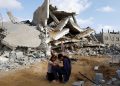

DaysofPal—More than two and a half years into Israel’s genocidal war on Gaza, thousands of Palestinians killed in the assault remain buried beneath vast mountains of rubble, turning the devastated Strip into both a mass grave and a growing environmental disaster.
An estimated 60 million tons of debris blanketed destroyed neighborhoods, trapping the bodies of countless victims beneath collapsed homes, hospitals, schools, and civilian infrastructure. For thousands of families, the war has not only taken their loved ones—it has denied them the dignity of recovering and burying them.
Rescue and recovery efforts remain critically limited. A severe shortage of heavy machinery, combined with ongoing Israeli restrictions on the entry of essential equipment and the continued danger posed by military attacks, has made large-scale debris removal nearly impossible.
As a result, thousands of people are still officially listed as missing, with many believed to remain buried beneath the ruins.
The prolonged presence of bodies under the rubble has raised growing concern among environmental and public health experts. While human remains alone are not typically the primary source of disease outbreaks, the combination of decomposing bodies, destroyed sanitation networks, contaminated water systems, accumulated waste, and overcrowded displacement camps has created conditions that threaten public health.
Experts warn that decomposition releases organic matter and gases that can affect soil quality and, in areas where infrastructure has collapsed, may eventually contaminate groundwater. At the same time, the destruction of water, sewage, and waste management systems has left Gaza increasingly vulnerable to environmental degradation and disease.
For grieving families, the crisis extends far beyond the physical devastation. Many have spent months—and in some cases years—searching for the remains of relatives, unable to perform funerals or lay them to rest. The absence of proper burials has prolonged their trauma, leaving thousands trapped in a cycle of uncertainty and grief.
Emergency crews continue working under extraordinarily dangerous conditions, navigating unstable rubble, repeated attacks, and a chronic lack of equipment. The sheer scale of destruction has overwhelmed local recovery efforts, with experts estimating that clearing Gaza’s debris could take years, delaying both the recovery of human remains and the reconstruction of entire communities.
Humanitarian organizations have repeatedly called for urgent international action to facilitate the entry of heavy machinery and technical teams capable of safely removing debris, recovering victims, and addressing the growing environmental consequences of the destruction.
Until that happens, countless Palestinian families remain suspended between hope and mourning, waiting for the chance to recover their loved ones while enduring the ongoing Israeli military campaign that continues to devastate Gaza and its civilian population.
Shortlink for this post: https://daysofpalestine.ps/?p=76094